PHAs are developing innovative strategies to enable more voucher residents to live in high opportunity neighborhoods with access to resources critical to their long-term success. There is considerable research suggesting that HCV program participants, especially those with young children, achieve better outcomes when they are able to use their voucher in a safe neighborhood with access to quality schools. CLPHA, along with the Poverty and Race and Research Action Council (PRRAC) sponsors the biennial National Housing Mobility Conference, which features presenters from the realms of research, policy, and practice to bring attendees up to date on developments in the field and spark discussions that will push the work forward.
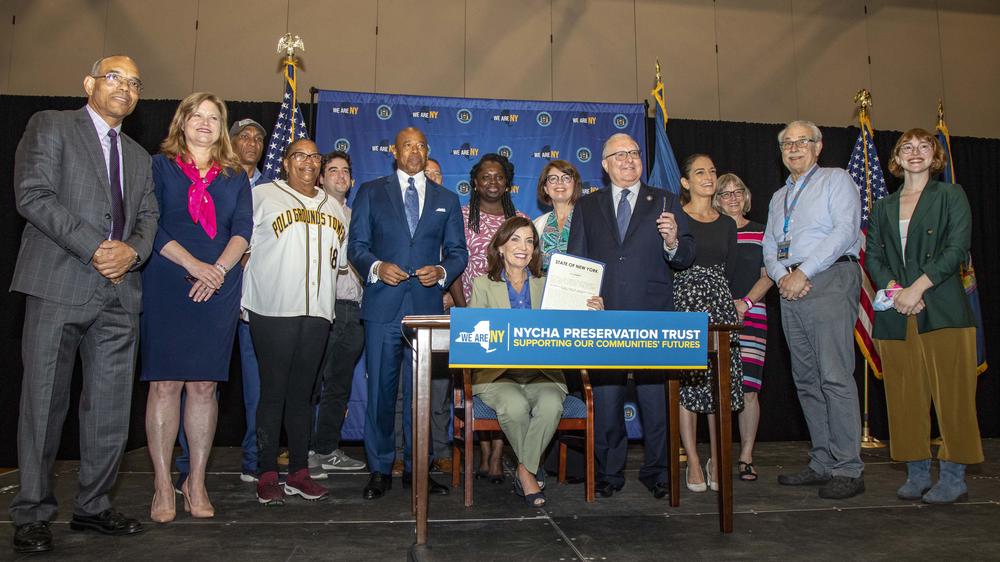

NYCHA Chair & CEO Greg Russ (second from right) with New York Governor Kathy Hochul (seated), New York City Mayor Eric Adams (front row, fourth from left), and other stakeholders at the signing of NYCHA's Public Housing Preservation Trust legislation. Photo credit: NYCHA
When you arrived at the New York City Housing Authority, what challenges did you encounter?
NYCHA has some of the oldest public housing in the nation – most of our buildings were built more than a half century ago – and we are grappling with more than $40 billion in urgent capital repair needs across the portfolio (a staggering figure that grows by about a billion dollars every year). This is the result of decades of government disinvestment from public housing and many missed cycles of investment in the buildings. And we know too well how aging buildings that haven’t received the investment they’ve needed over the years can impact residents’ quality of life and make our work to maintain and repair them even harder. Almost no repair is routine or simple, as the work needed expands into a much larger and more complex issue requiring skilled trades and multiple work orders – which is not the case with well-invested properties.
When I arrived at NYCHA in 2019 as Chair and CEO, the distressed conditions of the buildings was manifested by an Agreement that the Authority had recently entered into with HUD to address critical areas that most impact residents: lead, mold, heat and elevator services, and pest and waste management. The Agreement also carried with it a mandate to strengthen our organization through a Transformation Plan.
So I came to NYCHA at a very pivotal moment in its 88-year history. Before us was the work to make significant and sweeping changes to comply with the HUD Agreement, transforming key areas and fundamentally changing day-to-day operations to improve the way the Authority does business and improve residents’ quality of life. It is certainly an exciting time to be at NYCHA, with this opportunity to transform our properties as well as our organization.
Tenants' rights advocates were opposed to RAD conversions because they believed that tenant protections would be lost. How did you address their concerns?
PACT (Permanent Affordability Commitment Together) is what we call the implementation of RAD in New York City, and we have worked extensively with residents, advocates, and other community partners to develop the PACT program – always putting residents’ rights first – and to inform the community of the benefits of the program and how residents’ rights will be fully maintained. Sharing information and clear communication about the facts are key. We have a range of printed materials, videos, and web resources to ensure that residents have the latest information about PACT, and we host regular information sessions and meetings about resident rights and protections, the rehabilitation process, and other program elements. All of this information is available in multiple languages and is provided directly to every PACT household. We have also given tours of PACT projects so residents and other stakeholders can see firsthand the benefits of fully renovated homes and speak directly with residents about their positive experiences.
We created a PACT planning process that is transparent and that puts residents at the center of the process, including regarding the repairs and improvements they would like to receive at their developments. Residents are involved in selecting the developers, contractors, property managers, and social service providers that will renovate and maintain their developments. Residents also have the opportunity to review proposals, interview development teams, and help us select the partners best suited to serve their community.
The Blueprint for Change is a sweeping plan to recapitalize NYCHA's housing portfolio and improve living conditions and resident services. Why was such a dramatic proposal necessary?
We are reckoning with the Authority’s greatest existential threat in its history: the compounding effects of more than four decades of government disinvestment from public housing across the nation. With over $40 billion in capital needs, business as usual is not an option. The days of piecemeal fixes – of putting band-aids on our aging, deteriorating buildings – are over. It is also clear that we cannot rely on current funding levels alone to properly maintain our properties. Residents know this reality painfully well, with the near daily cascade of serious issues, from the rooftops to the pipes underground.
We have an opportunity now to turn NYCHA around and ensure it is here to serve New Yorkers for another half century and beyond – to provide residents with safe and healthy homes without the burden of having to deal with ceaseless repairs. Massive portfolio-wide investments not only transform residents’ homes but can also transform their lives: the construction work and implementation of new technologies is a very powerful economic stimulus that generates training and job opportunities for NYCHA families.
Our responsibility is to bring our buildings the investments they so desperately need, as quickly as we can, through initiatives such as the Public Housing Preservation Trust, PACT, and Comprehensive Modernization.
Now that the New York State legislature has adopted the Public Housing Preservation Trust legislation, and the Governor has signed it, what are the next steps?
The signing of the Public Housing Preservation Trust into law by Governor Hochul last month was a big step forward for NYCHA residents and very momentous for the future of public housing, and we are thankful for the support of all those who contributed to this milestone. The Trust gives residents a true voice in the future of their homes, and the updated legislation that passed incorporated feedback from residents that we have gathered over the past few years.
The Trust legislation enables residents to choose whether or not to move forward with the Trust at the developments, which is unprecedented. It also allows residents to be part of the process for selecting vendors to rehabilitate their developments and serve on committees that check the quality of this work. We will now continue engaging with residents, working with them and community partners to establish a model for the Trust, collaborating on details regarding its board, the resident voting process (by law, the draft voting requirements must be published by mid-October and the final voting requirements by mid-December), and other elements that provide a critical platform for residents. We have already begun to establish internal working groups to coordinate these processes. Once the Trust is established, the work to renovate the first 25,000 apartments will begin, which I’ll be thrilled to see.
From New York City Mayor Eric Adams' press release:
New York City Mayor Eric Adams, the New York City Department of Housing Preservation and Development (HPD), the New York City Housing Development Corporation (HDC), and homeless services nonprofit Project Renewal, today opened the first phase of Bedford Green House — a project that will bring 117 affordable and supportive homes to the Bronx. The project includes 71 apartments set aside for New Yorkers who previously experienced homelessness, families impacted by mental illness and substance use disorder, and people living with HIV/AIDS; with the remaining 46 apartments for low-income households earning up to 60 percent of area median income. Project Renewal is providing on-site wraparound social services, including horticultural therapy utilizing the greenhouse and aquaponic urban farming system on the building’s roof.
“Affordable housing, homelessness, public health, and our environment are all connected, and Project Renewal demonstrates the kind of creative thinking we need to tackle all of them together,” said Mayor Adams. “My administration is laser-focused, not on simply creating housing on paper but on getting New Yorkers into the safe, high-quality, affordable homes they deserve, while helping fight climate change and creating our own nutritious food. We are doing that today in the Bronx at Bedford Green House, and we will continue doing it all across the city.”
“Bedford Green House helps meet our city’s urgent need for supportive and affordable housing and embodies Project Renewal’s mission to empower individuals and families to renew their lives with health, homes, and jobs,” said Eric Rosenbaum, president and CEO, Project Renewal. “More than just an apartment building, Bedford Green House’s design and programming brings residents together, from children to seniors, around shared activities that support healthy living. As we celebrate the opening of this first phase, we look forward to the second phase, bringing more housing and services to more formerly homeless New Yorkers and the wider community.”
...
“Bedford Green House is what climate and housing justice looks like,” said HPD Commissioner Adolfo Carrión Jr. “Project Renewal is giving low-income and formerly homeless New Yorkers a new outlook on life with the opening of Bedford Green House. This development is a model for housing New Yorkers with dignity, while providing the services needed to live healthy lives. Thanks to Project Renewal, our partners at the city and state, and the entire development team for making this innovative and sustainable project a reality.”
From Fresno State University's press release:
As both Fresno State and Fresno Housing are committed to improving the living conditions of Central Valley residents, leaders of the two organizations signed a memorandum of understanding Friday to strengthen opportunities for academic and programmatic cooperation through education, affordable housing and community empowerment.
Since 1940, Fresno Housing has worked to increase the availability of quality housing for low-income families in the area, creating and sustaining vibrant communities throughout Fresno County.
“Housing insecurity is one of the most significant challenges impacting our community today,“ said Fresno State President Saúl Jiménez-Sandoval. “This partnership will allow us to create and support internships, expand service-learning opportunities and graduate assistantships that will engage Fresno State students in Fresno Housing projects and help empower our local community. Both our students and the greater community will benefit from the increased collaboration that will result.”
Through this partnership, both organizations seek to accomplish the following:
-
Develop and strengthen cooperative relationships between the staff of Fresno Housing and the academic departments and faculty of Fresno State.
-
Work toward alleviating housing insecurity for many Fresno State students.
-
Create and support internships, service-learning opportunities, and/or graduate assistantships that will engage Fresno State students in Fresno Housing projects and help empower local communities.
-
Mutually support grant applications that are focused on housing and community empowerment.
-
Work cooperatively together to identify potential funding sources to provide matching funds for Fresno Housing Scholarship recipients who attend Fresno State.
-
Convene forums in which Fresno Housing staff and Fresno State faculty can exchange and develop ideas for increasing housing accessibility and community education and empowerment.
“We are very proud and excited about this transformative partnership with Fresno State,” said Fresno Housing CEO Tyrone Roderick Williams. “We know that housing and education play a big role in a student’s journey to success. This partnership will work to create ways that we can support and provide opportunities for both Fresno State students and Fresno Housing residents alike, something that is very innovative and something we are very proud to be a part of.”
Many CLPHA member PHAs participate in special purpose voucher programs, such as the Family Unification Program (FUP), the Department of Housing and Urban Development and Veterans Affairs Supportive Housing Program (HUD-VASH), and the Non-Elderly Disabled (NED) program. These programs serve especially vulnerable low-income households who are in need of supportive services to ensure long-term housing stability. CLPHA members have created a variety of innovations to more effectively serve program participants.